ACP, UCP, AP2, MPP, x402, MCP and A2A: Protocol Landscape for Travel
Compare ACP, UCP, AP2, MPP, x402, MCP and A2A by the architecture layer they solve in agentic travel commerce.
Agentic-commerce protocols should not be treated as one winner-takes-all category. For travel architecture they sit at different layers: tooling, agent coordination, commerce interaction, payment authorization and payment rails.
Layer summary
| Protocol | Primary layer | Possible travel role |
|---|---|---|
| MCP | Tool/resource access | expose search, reprice, booking and servicing tools |
| A2A | Agent coordination | planner/payment/servicing agent collaboration |
| ACP | Agentic checkout / commerce interaction | agent-seller checkout and delegated-payment flows |
| UCP | Commerce interoperability | merchant/agent commerce capability discovery and checkout |
| AP2 | Payment authorization/evidence | mandates, verifiable intent, autonomous payment authorization |
| MPP | Machine payments | agent/API machine-native payments |
| x402 | HTTP-native payments | paid APIs and resources using HTTP 402 |
ACP
ACP defines purchase interaction and checkout interfaces between buyers, agents and businesses. In travel it is not a replacement for NDC or hotel booking APIs; it is better viewed as a commerce/checkout boundary around travel domain flows.
UCP
UCP targets interoperable commerce capabilities. Travel implementations should preserve reprice, availability and booking/ticketing semantics rather than forcing retail-cart assumptions directly onto travel offers.
AP2
AP2 focuses on agent payment authorization and evidence. Travel use cases include delegated limits, human-not-present transactions, verifiable intent and mandate evidence. It is not a booking protocol.
MPP
MPP addresses machine-to-machine payments. Travel examples can include paid supplier APIs, premium data services or machine-billed ancillary capabilities. It does not by itself solve consumer booking lifecycle.
x402
x402 brings programmatic payment to HTTP using 402 semantics. It fits paid APIs, premium resources and machine-commerce scenarios more naturally than core booking state.
MCP
MCP is a useful travel tool abstraction for search, reprice, create/retrieve/cancel and refund operations. It does not define authorization or booking semantics.
A2A
A2A standardizes collaboration among agents. A travel planner, loyalty agent, payment agent and servicing agent can coordinate through it while keeping their own domain responsibilities.
Protocol composition
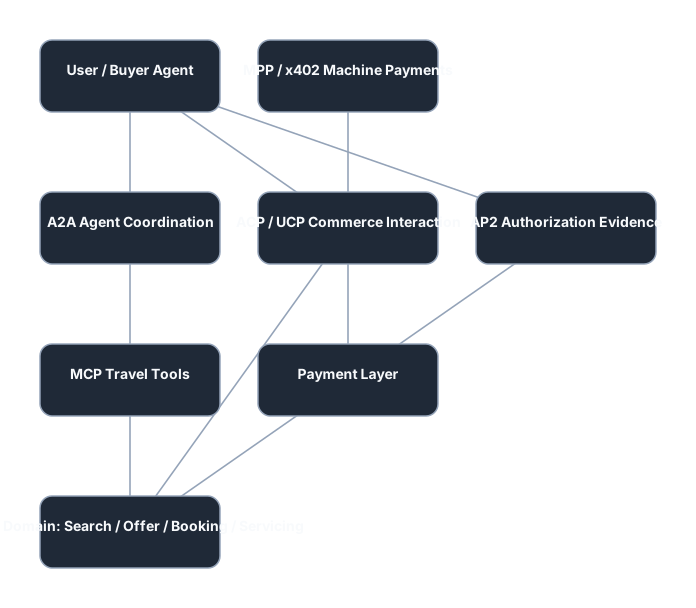 Agentic travel protocol composition
Selection criteria
Do not ask only which protocol to choose. Ask which problem layer exists: tool access, agent collaboration, checkout interoperability, delegated authorization or machine-native payment. A production system can use several protocols together.
Travel-specific constraints
Regardless of protocol, preserve offer freshness, reprice, UNKNOWN booking state, idempotency, payment/booking separation, passenger PII boundaries and servicing/reconciliation.
Failure modes
Treating a commerce protocol as the travel booking model, treating MCP invocation as authorization, equating payment success with booking success, version mismatch and losing travel-specific state under generic checkout abstractions.
Observability
Track capability-negotiation failures, version mismatches, protocol-specific error rates, authorization rejection, fallback-path usage and any travel-domain reconciliation triggered by protocol-layer ambiguity.
Production checklist
Maintain protocol-boundary maps, version pinning, capability negotiation, canonical travel models, authorization evidence, idempotent side effects, PII redaction and protocol-specific observability.
Let’s review your architecture.
We can assess your travel distribution and metasearch architecture for scalability, failure modes and operations.
Sources
Related content
Push vs Pull vs Hybrid for Travel Distribution
Compare push, pull and hybrid distribution models across freshness, latency, rate limits, caching, reconciliation and operational ownership.
Explore →Agentic Travel Authorization, Mandates and Human-in-the-Loop
Design user intent, mandates, delegated authority and human-in-the-loop checkpoints for AI-driven travel purchase and servicing side effects.
Explore →Agentic Travel Reference Architecture
Design AI agent → search → offer → reprice → confirmation → payment → booking → servicing with travel-specific authorization, idempotency and audit boundaries.
Explore →Bonotel Exclusive Travel: B2B Hotel Distribution Profile
A technical ecosystem profile of Bonotel as a curated B2B hotel distribution and wholesale partner with API-connected travel sellers.
Explore →Cendyn CRS: Central Reservations and Distribution Profile
A technical ecosystem profile of Cendyn's central-reservation and hotel-distribution role, including reservation services and live hotel-feed infrastructure.
Explore →Turkey Metasearch Market: Public-Evidence Technical Map 2026
Map Turkey's travel metasearch and distribution ecosystem across OTA, metasearch, GDS, NDC, bedbank, channel-manager, CRS and booking layers using public evidence.
Explore →