Sync vs Async Travel Booking Architecture
Compare synchronous and asynchronous travel booking orchestration across latency, recovery, UX and provider capabilities.
Choosing sync or async booking is not a framework preference. It defines the boundary between provider response semantics and the booking contract exposed to the traveler.
Short answer
Synchronous orchestration can be enough when the provider returns a definitive CONFIRMED/FAILED result within a predictable budget and supports authoritative recovery after timeouts. Use an asynchronous state machine when confirmation is delayed, delivered by webhook, or has highly variable latency.
Synchronous booking
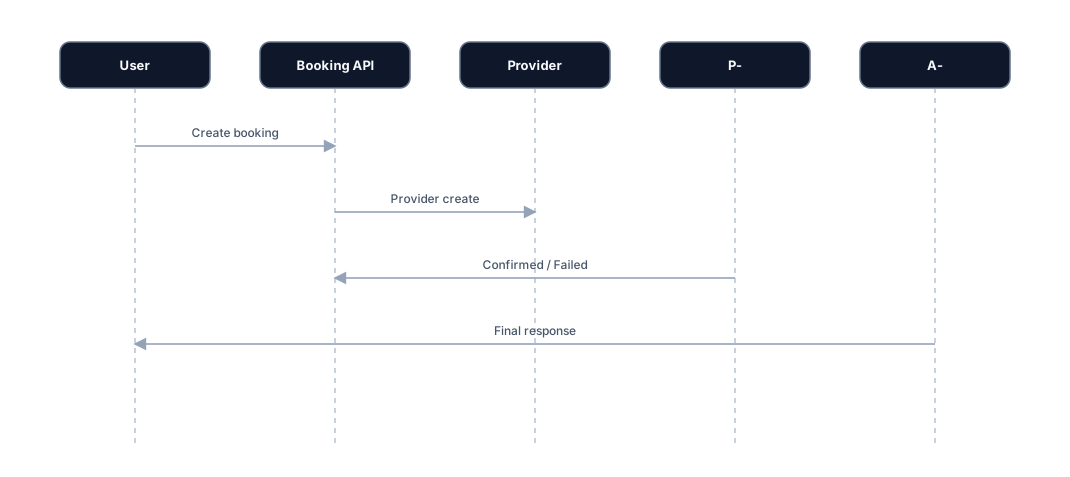 Synchronous booking flow
Benefits include simple UX and fewer moving parts. Risks include long-running requests, ambiguous timeouts, duplicate retries and direct exposure to provider latency.
Asynchronous booking
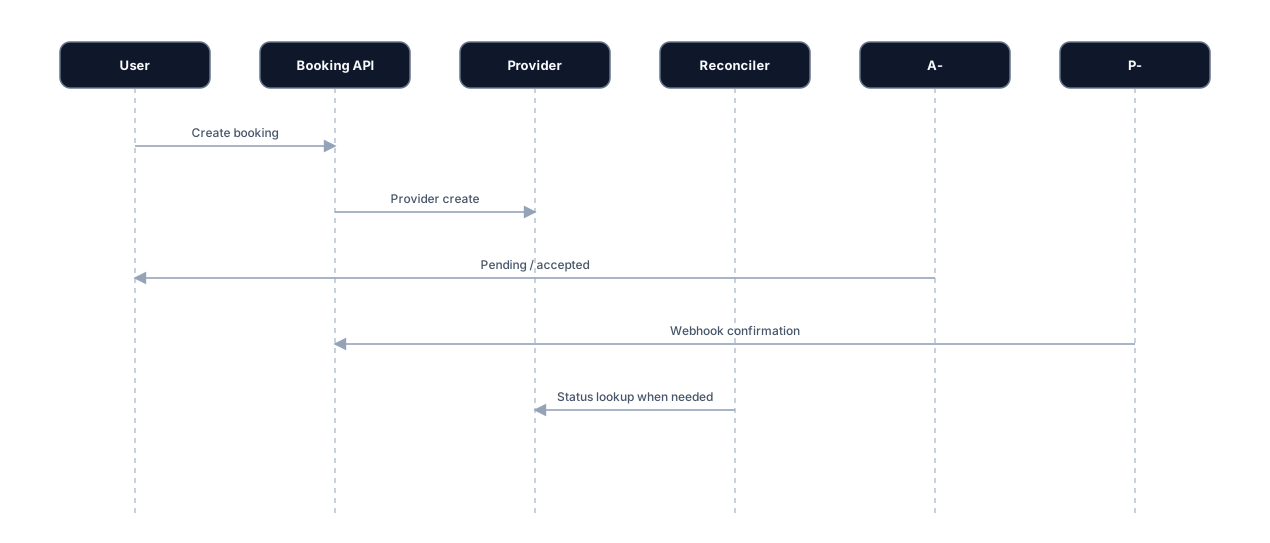 Asynchronous booking flow
The client can receive a non-terminal state such as PENDING, PROCESSING or UNKNOWN.
Decision matrix
| Signal | Sync fit | Async fit |
|---|---|---|
| Provider final-response latency | low/stable | variable/high |
| Final result in same request | yes | no |
| Webhook support | optional | valuable |
| Lookup/reconciliation | fallback | core mechanism |
| Client UX | immediate | must support pending |
| Recovery model | simpler | explicit state machine |
Hybrid model
Many production systems are hybrid: wait for a short synchronous budget, transition to PENDING/UNKNOWN when it expires, continue reconciliation in the background, and accept webhook evidence whenever it arrives.
Failure modes
- blind retry after HTTP timeout,
- marking async work FAILED too early,
- endless pending when webhook is lost,
- treating client disconnect as booking cancellation,
- applying both synchronous response and webhook twice.
Observability
Track synchronous completion rate, async fallback rate, confirmation latency percentiles, pending/unknown age, reconciliation time and duplicate-event rate.
Production checklist
Use explicit terminal/non-terminal states, separate transport timeout from business timeout, provider-specific budgets, idempotency, webhook deduplication, reconciliation fallback, polling backoff and manual-operations thresholds.
Let’s review your architecture.
We can assess your travel distribution and metasearch architecture for scalability, failure modes and operations.
Related content
Canonical Offer, Order and Booking State Model
Design canonical Offer, Order and Booking lifecycle boundaries with an explicit booking state machine for travel integrations.
Explore →Idempotency and Duplicate Booking Prevention
Design idempotency boundaries and duplicate-booking safeguards across travel booking, payment, cancellation and refund operations.
Explore →Hotelbeds API Suite: Bedbank Distribution Profile
A technical profile of the HBX Group Hotelbeds API Suite covering hotel booking, content and cache APIs for B2B accommodation distribution.
Explore →OTA vs Metasearch vs Travel Marketplace: Key Differences
Compare OTA, metasearch and travel-marketplace models by transaction ownership, supplier relationships, monetization, handoff and technical architecture.
Explore →Package Holiday vs Hotel Metasearch: Architecture Differences
Compare package-holiday distribution with hotel metasearch by offer identity, pricing, supplier topology, booking ownership and cancellation.
Explore →Sabre Travel APIs: GDS and Travel Distribution Profile
A technical profile of Sabre Travel APIs covering air, lodging, car, booking and agency workflows across a GDS-oriented B2B platform.
Explore →