Travel PII and Passenger Data Boundaries
Design safe boundaries for passenger identity, contact, payment and travel-document data across search, booking, logging and provider integrations.
Travel systems can often search anonymously, but booking and servicing may require passenger identity, contact and document data. The key principle is to open PII only at the boundary that needs it instead of carrying raw passenger data through the whole domain.
Data boundary
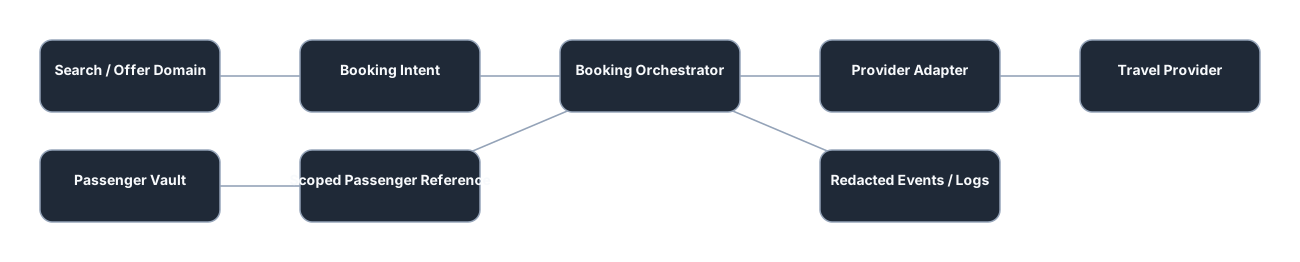 Passenger data boundary
Data classes
Classify passenger name, email/phone, date of birth, nationality, identity documents, loyalty numbers, special-service requests, payment identifiers and booking references separately. They do not necessarily share the same access or retention policy.
Token/reference pattern
Use an internal reference instead of propagating raw passenger records into search, analytics and observability:
passengerProfileRef -> secure vault lookup -> scoped provider payloadLeast privilege
A provider adapter should only access fields required for the active booking operation. Search and ranking services should not see passport or phone data.
Logging
Never log full provider request bodies, passport numbers, raw email/phone, payment details or authentication tokens. Prefer operational identifiers such as canonical booking ID and provider reference.
Encryption and secrets
Protect sensitive data at rest and in transit, rotate keys, and keep provider credentials separate from passenger-data surfaces.
Retention
Retention should be tied to booking lifecycle, servicing/refund windows, legal/accounting requirements, fraud/dispute needs and explicit deletion/anonymization policy.
Analytics boundary
Use business fields such as market, route/destination class, booking state, provider, amount bucket and latency instead of raw PII in analytics events.
Support and operations access
Show masked data by default. Revealing sensitive fields should require explicit permission and produce an audit trail.
Failure modes
PII in traces/logs, real passenger data in fixtures, email in analytics pipelines, passport/email used as cache keys, uncontrolled provider error-body persistence and backup retention longer than primary-data policy.
Observability
Track redaction failures, unauthorized reveal attempts, sensitive-field access, retention deletion failures and raw-payload persistence detection.
Production checklist
Use data classification, a PII-free search domain, secure passenger references, scoped adapter access, redaction, retention policies, masked operations UI, audited reveal, sanitized fixtures and backup/deletion parity.
Let’s review your architecture.
We can assess your travel distribution and metasearch architecture for scalability, failure modes and operations.
Related content
Canonical Offer, Order and Booking State Model
Design canonical Offer, Order and Booking lifecycle boundaries with an explicit booking state machine for travel integrations.
Explore →Idempotency and Duplicate Booking Prevention
Design idempotency boundaries and duplicate-booking safeguards across travel booking, payment, cancellation and refund operations.
Explore →Hotelbeds API Suite: Bedbank Distribution Profile
A technical profile of the HBX Group Hotelbeds API Suite covering hotel booking, content and cache APIs for B2B accommodation distribution.
Explore →OTA vs Metasearch vs Travel Marketplace: Key Differences
Compare OTA, metasearch and travel-marketplace models by transaction ownership, supplier relationships, monetization, handoff and technical architecture.
Explore →Package Holiday vs Hotel Metasearch: Architecture Differences
Compare package-holiday distribution with hotel metasearch by offer identity, pricing, supplier topology, booking ownership and cancellation.
Explore →Sabre Travel APIs: GDS and Travel Distribution Profile
A technical profile of Sabre Travel APIs covering air, lodging, car, booking and agency workflows across a GDS-oriented B2B platform.
Explore →